

Why & Where Does Cholesterol Deposit ?
And Where to Listen for Bruits During the Cinical Exam

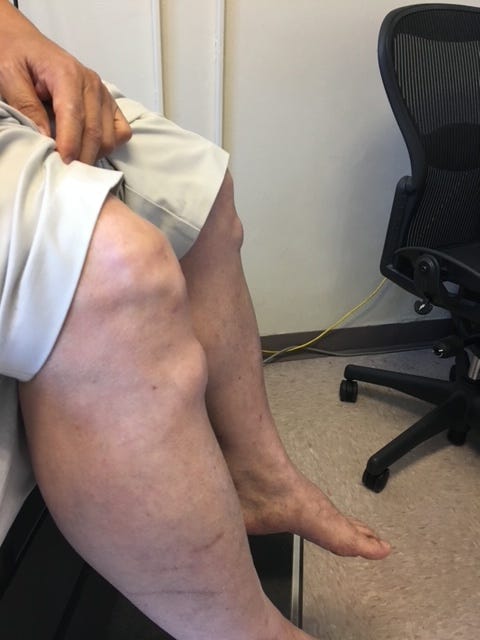
The last post discussed how the cholesterol deposits in tendons are often related to repetitive minor injury. Continuing that theme, this post’s photo shows another patient with tendon xanthomas, but these are on the tibial tubercle where the quadriceps tendon inserts. This man was a runner and running puts stress on this insertion point. The repetitive injury led to xanthoma at this location.
The injury theory of cholesterol deposition also explains where patients tend to form atherosclerotic lesions and create vascular bruits. Bruits are the sound created by blood being pushed through a narrowed vessel. The carotid siphon and the carotid bifurcation, the bifurcation of the aorta, and the femoral artery in the groin are frequent sites of cholesterol deposition. All are branch or twist points that disrupt the blood’s laminar flow and create turbulence. The turbulence creates injury. Also, cholesterol tends to deposit in the “low pressure sink” areas of these bends, similar to how debris collects along a twisting river along the inside or shortest bank of the bend. The water has to flow faster around the outside or wider part of the bend, so it scours the debris from that side. The debris deposits on the inner bend. Consequently, when doing a vascular exam on a patient, the areas of highest yield are those areas with bends such as the carotids, the abdomen at the umbilicus (because the aortic bifurcation sits behind the umbilicus), and the femorals in the groin, because they bend a lot during sitting.
I have never seen this stated (and I even asked Dr. Google), but I suspect that we get atherosclerosis in the coronary arteries (as evidenced by coronary calcium) before we get it in other places, because the coronary arteries have to twist and turn when the heart contracts. The coronary arteries are plastered to the heart and have to go along for the ride so any twisting and turning creates turbulence leading to the atherosclerosis. Remember, I am just making this up, but there is support for this idea. One of my friends, Polly Beere, MD, PhD, fed monkeys high fat diets and ablated the sinus node in half of the animals to slow their heart rates. Those monkeys with slower heart rates got less atherosclerosis in the carotids (1) and coronaries (2) than animals with higher heart rates. Slower heart rates created less frequent turbulence leading to less atherosclerosis was the possible mechanism. This may also be part of the reason people with slower heart rates live longer, but I am sure it’s not the only reason.
So, the rules please:
· 1. Listening over the carotids, umbilicus and femorals is most likely to detect a bruit.
· 2. Asymptomatic slow heart rates are good.
1. P A Beere 1, S Glagol, C K Zarins. Experimental atherosclerosis at the carotid bifurcation of the cynomolgus monkey. Localization, compensatory enlargement, and the sparing effect of lowered heart rate. Arterioscler Thromb. 1992 Nov;12(11):1245-53. PMID: 1420083
2. P A Beere, S Glagol, C K Zarins. Retarding effect of lowered heart rate on coronary atherosclerosis. Science. 1984 Oct 12;226(4671):180-2. PMID: 6484569
#cholesterol #genetic hypercholesterolemia #xanthoma #atherosclerosis #slow heart rates #bradycardia
There is a lot of clinical evidence for this. I propose that it is the product of (turbulence x pressure) x cholesterol levels = plaque formation.
Therefore hypertension is a problem, also leading to plaques in endurance athletes (because of higher turbulence and blood pressure during exercise training).
Martin Halle from Munich, Germany
thank you